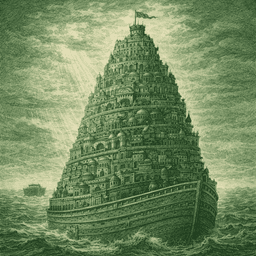
alt title: How I think the world will end
To: Times of Our United Worlds, Attn: Editorial Board
Date: November 12th, 2215
Subject: The Last Flood
There are presently 2.4 million inhabitants of old-Earth. While official channels remain closed, on occasion humanitarian missions have been permitted a return to our homeworld. An anthropologist by training, one regards invitations to join such expeditions as the highest fortune that may befall our profession.
Selected literature, treatments on the crafts, archaic religious texts, and written histories were printed and collected into several large pallets which were then to be delivered to old-Earth’s major settlements. It is hoped this restoration of their lost culture and history will raise the Earthings’ amnesia concerning our shared history; and that it might set-forward the cause of re-unification that has evaded a generation of diplomats.
I was pleased that our commission had the foresight to send ahead a small team, which I led, to catalog the prevailing stories so that a record of these people’s lore might survive undisturbed by our endowment. A colleague in my academy’s biology department put it starkly “[you] are being dispatched to take pictures of the natural wildlife, before releasing onto that ecosystem a zoo of invasive species.” He will be proven right on balance, but there is one story so stubbornly misremembered by the peoples of old-Earth that it resisted every attempt at correction:
The story concerns a man named Noah who god charges with building an ark. A great flood is imminent, a judgment in both senses: a verdict (man is damned) and a payment of restitution (assessed on all that they had built).
Noah alone is given forewarning and, with his family, is instructed to build an ark large enough to exclude 2 of every animal from the coming doom. The Ark, is a seed, to regrow the world after the water recedes. For many years Noah and his sons dedicated all their every energies to fulfilling this great duty bestowed on the family by their God.
Unknown to them in a faraway land, a man of science had by his own methods become aware of the coming deluge. He tasked his own apprentices with designing a vessel and funded the project with the gains of his myriad ventures. Not content with simple rows of stables, the learned man insisted that entire ecosystems with their web of food chains and habitats be preserved. So it was that entire decks were built with trees, terrain and water features to simulate the weather. And after each was finished, another, for a different climate, would be built atop the last.
Once the decks for the natural world had been completed, the learned set themselves to the work of designing a final deck for the human passengers. But their patron was again dissatisfied with each revision brought to him, until at last he took the work upon himself.
He ordered construction to resume, not of one final deck, but of many more, for each of the peoples of the earth deserved to have their culture preserved into the coming age. Places of worship were meticulously crafted to house every pantheon known to the builders. Homes and town squares in the style of each great nation came next. And finally craftsmen were imported the world over to staff the shops so each passenger could wear the clothes, and use the tools, and enjoy the cuisine of his homeland.
This Ark Colossus now stood high above any previous work of man, but still it was unfinished. Its Patron, wise as he was, could foresee challenges few others would attend to. How would all these nations, plucked from their corners of the map and placed in close quarters get along? Differences and prejudices — like a far-away torch — were dim at a distance but burned brightly up close. So at a great and further expense of time and labor each living space was doubled in size. The Ark climbed ever further skyward.
But even those additions did not satisfy the fears of the now aging Patron. An Ark-wide government, with administrators of the highest credentials would be needed to mediate the relationship between the decks. And these bodies required chambers for deliberation, and quarters for their members, and a place for writing and a school to teach the common language created for all inter-ark-affairs. And these floors must be majestic and inspire awe, to seduce the disparate into a unified whole. And so the top five decks were furnished of marble and finally this Ark Colossus was made complete.
The Patron called immediately for the Ark to be christened. The most beautiful maiden, herself a passenger to-be, smashed the vessels together so the tiny one might break. The crowd cheered as the builders began cutting lines. The Ark Colossus began to roll out of its scaffolds and into the sea. And at its bow a magnificent wave pushed out ahead. Higher it rose, accelerating towards the world to be saved. And as the stern finally made contact a wave rose above spectators, becoming their final sight.
The deluge that began in this harbor freed all the seas from their shores and washed away the world save for our Noah and his flock, who were carried to safety by their modest Ark. Their Ark found ground, the world reborn. And still sometimes late at night sailors claim to see a massive ghost ship on the horizon, fated to circumnavigate for all eternity as a penance or reminder.
* * *
When representatives of the United Worlds first returned to old-Earth a century ago, they noted how the Earthlings referred to our envoys as: “the men from the big ship.” At the time our experts coded this appellation as a sign of primitiveness—proof, they thought, that the natives were as children thinking only with what they could see. But I have now been to old-Earth, and I have not met anyone primitive on this rock. Perhaps it is we who have amnesia.